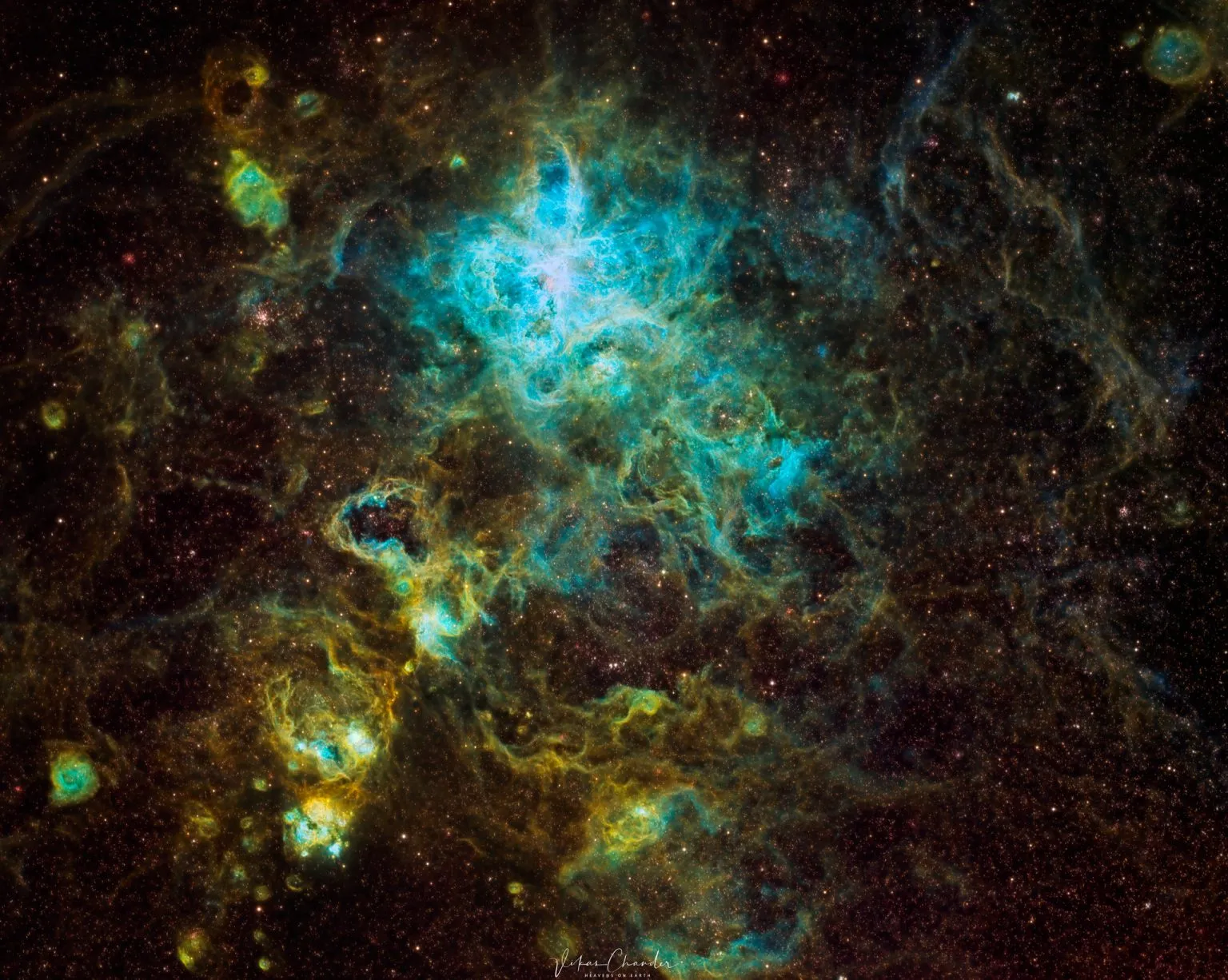
The Tarantula Nebula, a vast and vibrant cloud of gas and dust, is one of the most active star-forming regions in our galactic neighborhood. This stunning nebula, also known as 30 Doradus, presents a breathtaking spectacle for astronomers and stargazers alike. This article delves into the captivating facts about the Tarantula Nebula, exploring its structure, significance, and what makes it a fascinating subject of astronomical study. Prepare to be amazed by the cosmic wonders hidden within this stellar nursery, as we uncover seven key facts about the Tarantula Nebula that you absolutely must know.
What is the Tarantula Nebula (H2)
The Tarantula Nebula is an enormous HII region situated in the Large Magellanic Cloud (LMC), a satellite galaxy of the Milky Way. It is a powerhouse of star formation, harboring thousands of young stars and stellar clusters. The nebula’s name comes from its appearance, which resembles a giant spider, with glowing filaments of gas and dust extending outwards. This region is much more active than the Orion Nebula, a well-known star-forming region in our own galaxy, making the Tarantula Nebula a unique laboratory for studying the processes of star birth.
Location and Visibility (H3)
Understanding the Tarantula Nebula’s location is key to appreciating its significance. Located in the Large Magellanic Cloud, the nebula is approximately 160,000 light-years away from Earth. This distance makes it a challenging object to observe with the naked eye, but it is easily visible with binoculars or a small telescope under dark sky conditions. Its location in the southern celestial hemisphere also means that it is best viewed from locations south of the equator.
Where is the Tarantula Nebula located (H4)

The Tarantula Nebula is found within the Large Magellanic Cloud, which is a dwarf galaxy orbiting our Milky Way. Specifically, it’s located in the constellation Dorado, making it relatively easy to pinpoint once you locate the LMC. Dorado, which means ‘Goldfish’ in Latin, is a constellation easily recognizable in the southern hemisphere skies. Finding the LMC itself is the first step, which can be located as a faint, elongated patch in the night sky, and within it, the Tarantula Nebula shines brightly.
How to observe the Tarantula Nebula (H4)
Observing the Tarantula Nebula is a rewarding experience for both amateur and professional astronomers. While it is not visible to the naked eye, even a small telescope reveals its intricate details. The best way to observe it is to find a location with minimal light pollution and use a telescope with at least a 4-inch aperture. Using a wide-field eyepiece will allow you to capture the full extent of the nebula. Alternatively, astrophotography allows you to capture stunning images of the Tarantula Nebula, revealing colors and structures invisible to the naked eye.
Formation and Structure (H3)
The Tarantula Nebula’s formation is a dynamic process driven by the intense radiation and stellar winds from its massive stars. The nebula is primarily composed of hydrogen gas, along with helium and traces of heavier elements. These gases are ionized by the ultraviolet radiation emitted by the young, hot stars within the nebula, causing them to glow. The structure of the nebula is sculpted by the stellar winds, creating intricate filaments and bubble-like formations. The nebula’s bright appearance is a testament to the ongoing star formation within it.
Star Formation (H4)

The Tarantula Nebula is a prolific star-forming region, hosting the formation of thousands of stars. The process begins with dense clumps of gas and dust collapsing under gravity. As the material collapses, it heats up, eventually igniting nuclear fusion and forming a star. This process is particularly active in the Tarantula Nebula due to the high concentration of gas and the presence of massive stars that trigger further star formation. Studying star formation in the Tarantula Nebula provides valuable insights into how stars are born.
Presence of Massive Stars (H4)
One of the most striking features of the Tarantula Nebula is its abundance of massive stars. These stars are significantly larger and more luminous than our Sun, and they have a profound impact on their surroundings. Their intense radiation and stellar winds shape the structure of the nebula, and their eventual demise in supernova explosions enriches the interstellar medium with heavy elements. The presence of these massive stars makes the Tarantula Nebula a key site for understanding the life cycles of stars.
Key Facts About Tarantula Nebula (H2)
Fact 1 Size and Distance (H3)

The Tarantula Nebula spans approximately 1,000 light-years in diameter, making it one of the largest HII regions known. It is located roughly 160,000 light-years away from Earth, in the Large Magellanic Cloud. This vast distance underscores the nebula’s immense size and the energy it generates. Its sheer scale is a testament to the powerful forces at play, including stellar winds and radiation from massive stars.
Fact 2 Brightness and Luminosity (H3)
The Tarantula Nebula is incredibly bright, with a luminosity that rivals many entire galaxies. This intense brightness is due to the vast number of young, hot stars within the nebula, which emit enormous amounts of ultraviolet radiation. This radiation ionizes the surrounding gas, causing it to glow brightly in various colors. This intense luminosity makes it a prominent feature of the Large Magellanic Cloud, easily visible through telescopes.
Fact 3 Stellar Nursery (H3)
The Tarantula Nebula is a prolific stellar nursery, actively forming new stars at a rapid rate. The nebula’s dense clouds of gas and dust are ideal environments for star formation. Astronomers estimate that the Tarantula Nebula is home to thousands of young stars, many of which are massive and short-lived. This active star formation makes the Tarantula Nebula a key area for studying the processes of star birth and evolution.
Fact 4 Supernova Activity (H3)

The Tarantula Nebula is a hotbed of supernova activity, with several supernovae observed within its boundaries. These supernova explosions occur when massive stars reach the end of their lives and violently explode. One of the most famous supernovae, SN 1987A, occurred within the Tarantula Nebula, providing astronomers with a wealth of data on supernova remnants and the evolution of massive stars. The frequency of supernova events makes the Tarantula Nebula a crucial area for studying stellar death and the recycling of elements in the universe.
Fact 5 The Central Cluster R136 (H3)
At the heart of the Tarantula Nebula lies the massive star cluster R136. This cluster contains some of the most massive and luminous stars known, including many Wolf-Rayet stars and O-type stars. R136 is responsible for much of the energy and radiation that illuminates the nebula. Its presence highlights the intense star formation occurring within the Tarantula Nebula, making it a fascinating subject for astronomers. The study of R136 gives insights into the formation and evolution of massive stars.
Fact 6 Chemical Composition (H3)
The Tarantula Nebula is primarily composed of hydrogen and helium, with traces of heavier elements. The abundance of these elements in the nebula reflects the composition of the Large Magellanic Cloud and the interstellar medium. Studying the chemical composition of the nebula provides insights into the star formation processes and the enrichment of the interstellar medium. The elements heavier than helium are created within stars and dispersed into space during supernova explosions, enriching the nebula and providing materials for future star formation.
Fact 7 Significance in Astronomy (H3)

The Tarantula Nebula is of significant importance in astronomy. It serves as a crucial laboratory for studying star formation, the evolution of massive stars, and the impact of supernovae on the interstellar medium. Its proximity and the high rate of activity make it an ideal target for observation and study. Astronomers use the Tarantula Nebula to understand the formation of stars and galaxies and the processes that shape the universe. It provides insights into the life cycle of stars and the chemical evolution of galaxies.
The Future of the Tarantula Nebula (H2)
The future of the Tarantula Nebula is dynamic, with ongoing star formation and the eventual demise of massive stars. As stars continue to be born, the nebula will evolve and change. The most massive stars will eventually explode as supernovae, enriching the interstellar medium with heavy elements and shaping the nebula’s structure. Over millions of years, the Tarantula Nebula will continue to transform, leaving behind stellar remnants and new generations of stars. The ongoing activity in this region makes it a unique place to study the cosmic cycle of birth, life, and death of stars. The Tarantula Nebula provides continuous scientific opportunities for new discoveries.
In conclusion, the Tarantula Nebula is a spectacular and significant object in the universe, offering invaluable insights into star formation, stellar evolution, and the life cycles of stars. Its impressive size, brightness, and active star-forming regions make it a unique and captivating subject. Through studying the Tarantula Nebula, we continue to expand our understanding of the cosmos. Its features, including the location, the presence of massive stars, and the ongoing supernova events, make it a key object for astronomical research. For those interested in astronomy, the Tarantula Nebula offers a glimpse into the dynamic and awe-inspiring processes that shape the universe.